
Absorb Impact
Built to absorb impact — and spring back
Two properties describe how a material handles impact: resilience — the energy it stores and releases elastically, springing back to shape — and toughness — the total energy it absorbs before it fractures. These behave differently: resilience is set almost entirely by strength, while toughness needs strength and ductility together. Super Aluminum leads conventional high-strength aluminum on both, because it pairs very high strength with retained ductility.
Measured Stress–Strain Curve
Both properties below are read directly from Super Aluminum’s measured tensile curve — high strength held together with sustained elongation.
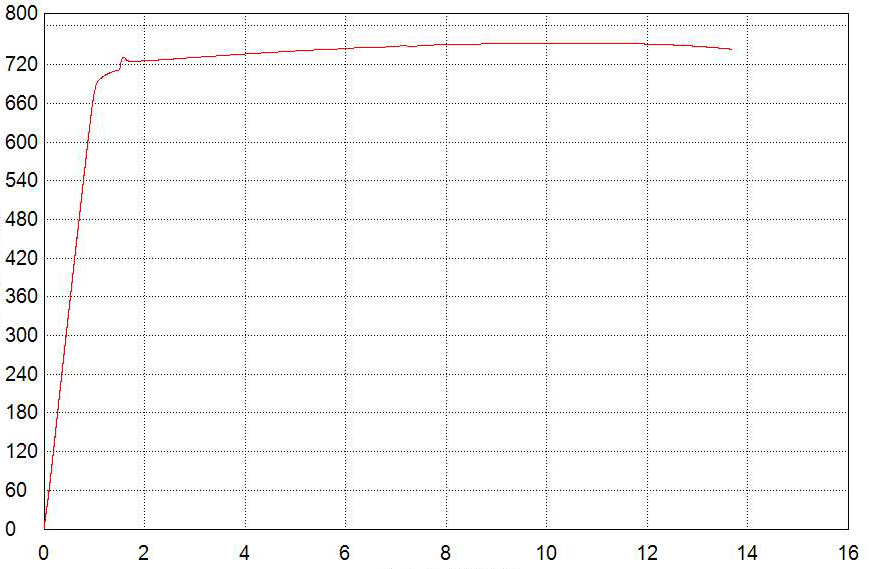
Super AL-T6 tensile stress–strain curve · ASTM E8
Modulus of Resilience
Energy a material stores and releases elastically, returning to its exact original shape without any permanent deformation. The higher the value, the better it springs back after an impact.
Modulus of Toughness
The total energy a material absorbs before it actually fractures — strength multiplied by how far it stretches. The higher the value, the more punishment a part can take before cracking or breaking.
Why the toughness lead exists: it breaks the strength–ductility trade-off
For conventional alloys, strength and ductility pull against each other — raising yield strength drives elongation down, so they line up along a single declining curve. Because toughness is strength × elongation, it can’t be bought with strength alone: a very strong but brittle alloy can absorb less energy than a softer ductile one. Super Aluminum sits above that curve, holding high elongation at a yield strength well beyond 7075 — which is exactly why its toughness pulls ahead instead of falling back.
Yield strength vs. elongation. 6061-T6 and 7075-T6 fall on the conventional trade-off line; Super AL-T6 sits above it — high strength without giving up ductility.
What this means in practice
- Survives drops and sudden impacts without permanent dents, bending, or cracking.
- Springs back to its original shape instead of taking a permanent set.
- Absorbs more energy before fracture — greater margin against shock and overload.
- Ideal for springs, fasteners, clips, and any part exposed to impact or vibration.
| Alloy | Yield (MPa) | Elongation (%) | Resilience (MJ/m³) | Toughness (MJ/m³) |
|---|---|---|---|---|
| 6061-T6 | ~276 | 12 | 0.55 | ~35 |
| 7075-T6 | ~503 | 5–11 | 1.76 | ~43 |
| Super AL-T6 | 663–704 | 9–14 | 3.0–3.6 | ~81 |
6061-T6 and 7075-T6 figures are typical published properties for the T6 temper. Modulus of resilience = (yield strength)² ÷ (2 × elastic modulus), with E ≈ 69–73 GPa for these alloys, so resilience scales with the square of yield strength. Modulus of toughness is estimated as the average of yield and tensile strength × elongation at fracture; actual values depend on the full stress–strain curve. Strength and elongation normally trade off across alloys — Super AL’s position above that line reflects retained ductility at high strength. Super Aluminum values are based on Super AL-T6 certified test data.